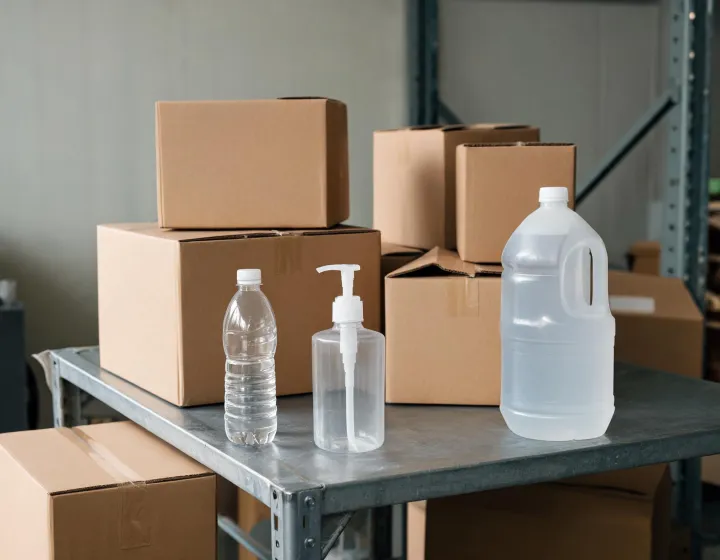
Food, personal care and industrial uses that change the RFQ
These bands are purchase settings, not customer testimonials. Pet Bottle Sourcing does not publish named accounts or savings percentages. Ahrefs US matching-term observations dated 2026-09-20 for this cluster show shopping and question modules; they are search labels, not ranking claims.
Food & beverage
Still and carbonated beverage fill
Write fill volume, carbonation, and whether the bottle will sit in a cold chain. Oxygen transmission rate on monolayer PET is higher than glass; some aroma-sensitive juices still need a barrier coating or a multilayer structure. That is a selection trade-off, not a recyclability slogan. Ask for the lot food-contact or migration testing file before the first inbound. FDA 21 CFR review language applies to named resin and process, not to this website.
Personal care
Lotion, cleanser and pump programs
Disc-top, lotion-pump and sprayer necks are different families. Write the closure and whether a pressure-sensitive adhesive label or a shrink sleeve will cover the shoulder. Recycled PET can shift shade and intrinsic viscosity. Treat post-consumer recycled content as a resin grade with a file, not as a marketing stripe. A later handle or pump swap is a new tooling line.
Industrial
Concentrates and household liquids
Heavier gram weights, trigger necks and pallet drawings belong here. Edge crush test language belongs to corrugated shippers around the bottles, not to the PET wall itself. Do not copy ECT onto a bottle RFQ. Burst or drop results, if supplied, apply to the tested pack-out only.
Material and method comparison
Mono-material PET can improve recycling reporting when the buyer can accept the oxygen and water vapor transmission rate of that wall. Barrier coatings or multilayer structures may still be needed for retort-adjacent or aroma-sensitive fills; those constructions change both the quote and the recycling file. Digital print versus flexographic printing is a run-length decision for sleeves and labels: high SKU counts can reduce plate cost with digital print, while stable long runs often keep spot-color control better in flexo. Write run length and color-critical graphics before you treat either process as the default.
Glass versus plastic remains a buyer choice on the same fill: glass can suit inert contact and shelf presentation; PET can cut shipping weight and breakage. Destination constraints such as a lot-specific statement before unload belong on the RFQ. Continue on inquiry options or send the application brief.