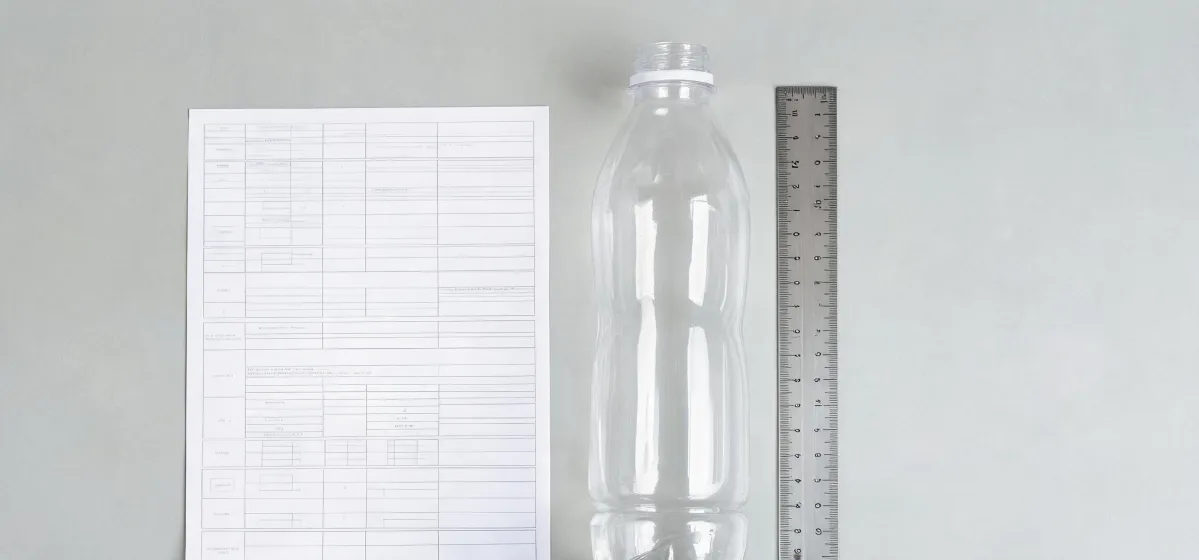
I've been buying packaging for a 180-person personal care company for six years now. In Q1 2025, we ran a pet bottle sourcing round for a custom 16oz PET bottle — new line, so no existing vendor relationship to lean on. We sent the same spec sheet to eight pet bottle manufacturers and got eight quotes back. The two that made it to the final round looked like this: $0.17 per unit vs. $0.21 per unit.
On paper, that's a 24% gap. My first instinct — and honestly the instinct of anyone new to this — is to go with the 17-cent quote. I almost did. Then I ran both through the landed-cost sheet we've been building since 2022, after I got burned twice on "free setup" offers that weren't actually free.
Here's how the two options actually compared across five dimensions. I'll call them Quote A and Quote B to keep it clean, but the pattern is one I've now seen repeat across maybe 30 sourcing decisions.
Dimension 1: Unit Price vs. Landed Cost
Quote A came in at $0.17/unit for 50,000 units. Quote B was $0.21/unit for the same volume.
But Quote A's unit price excluded tooling ($3,200, one-time), freight to our Ohio warehouse ($0.025/unit), and a $400 sample-and-approval fee. Amortized over a 50,000-unit first run, A's landed cost came out to $0.243 per unit — plus the tooling had to be re-paid on any reorder below 100,000 units.
Quote B's $0.21 included the mold (they were running a similar shape for another customer, so we only paid a $900 shared-tooling fee), freight, and two rounds of pre-production samples. Landed cost: $0.228 per unit.
So the "24% cheaper" quote was actually 6.5% more expensive once everything was in the math. (Should mention: I've watched this pattern hold up through the PET resin price swings of 2023 and 2024 — the unit-price spread usually shrinks or flips once tooling amortization is included.)
My rule now: ask for a landed-cost quote before you ask for a unit-price quote. Any pet bottle manufacturer or pet bottle supplier who can't give you one either doesn't know their own cost structure or is hoping you won't ask.
Dimension 2: What's Actually Included (and What Isn't)
This is the dimension where the two quotes diverged the most — and where the transparency question really lives.
Quote A's breakdown:
- $0.17/unit bottles
- Tooling: $3,200 (quoted separately, "typical for this spec")
- Freight: billed at actual, estimated $0.025/unit
- Sample fee: $400 for first round
- Mold maintenance: not addressed
- QC: "per industry standards" (no specifics)
Quote B's breakdown:
- $0.20/unit bottles
- $900 shared-tooling fee
- Freight included (2 pallets, LTL, to Ohio)
- Two sample rounds included
- Mold maintenance included for first 12 months
- QC: 3-point inspection per AQL 2.5, documented per batch
The line-item difference tells you something. Quote A's $0.17 was doing a lot of work — it looked competitive because the expensive stuff lived outside the number.
I've learned to ask what's not included before I ask what the price is. If the answer is "nothing, it's all-in," that's actually a yellow flag when the number is suspiciously low. Usually it means they haven't thought through the full spec yet. Put another way: a quote that fits on one line is hiding the other lines somewhere.
Dimension 3: Minimum Order and Flexibility
Here's where Quote A's lower unit price started looking less attractive.
Quote A required a 50,000-unit minimum on the first run, with no reductions on reorders unless we hit 100,000. For a new product line, that meant committing roughly $12,150 in cash (50,000 × $0.243 landed) before we had any real sales data.
Quote B offered 20,000-unit minimums with a price curve that only kicked up $0.015 per unit at the lower volume. Our initial commit at B's terms was around 8,000 units — roughly $1,900 in cash. If the line performed, we'd scale to 50,000 and the unit price would drop to $0.218.
For a company our size, this mattered more than the 4-cent unit spread. It's easy to obsess over unit price and forget that minimum order value is a cash-flow decision, not a purchasing one.
Looking back, I should have factored working-capital cost into my very first PET sourcing round in 2022. I didn't, and we tied up $18,000 in inventory that took four months to move. That's roughly $900 in opportunity cost at our line of credit, plus warehouse space we didn't have.
Dimension 4: Quality Risk and Redo Cost
The surprise wasn't in the numbers. It was in the quality documentation.
Quote A had no batch-level QC documentation. Their "per industry standards" language, when I pushed, turned out to mean visual inspection of a random sample per pallet. No dimensional checks. No weight verification. No documentation we could independently review.
Quote B sent over a sample batch report before we even ordered — dimensional tolerances, neck-finish measurements, wall-thickness variance, all logged per batch.
I've been burned on this one before. In Q2 2024, a different pet bottle supplier (not either of these two) shipped 12,000 bottles where the neck finish was 0.12mm out of spec. That's small — but it was enough to fail our capping line. The redo cost $1,200 in replacement product plus three weeks of production delay. On a $2,900 order.
The irony: the original quote on that order was about 8% lower than the alternative we'd considered. That 8% looked pretty good at the time. It cost us 41%.
Dimension 5: Lead Time and Communication
Quote A: 8–10 week lead time, contact through a shared email alias, average response time about 3 business days (I tested this — sent a spec question on a Monday, heard back Thursday evening).
Quote B: 6-week lead time, named account manager with a direct line, average response time about 6 hours (tested the same way).
For a first-run product, the 2-week delta in lead time matters more than it sounds. It compresses or expands your window to test-market, collect feedback, and reorder before your next season. Plus — and this is the part I used to underestimate — you learn more about a supplier in one rush question than in the entire RFP.
So Which One Should You Actually Choose?
Neither quote is wrong for every situation. Here's my decision framework now, based on what I learned from this round:
Choose the bare-bones, low-unit-price quote if:
- You have in-house QC and can inspect incoming batches yourself
- Your annual volume is high enough that tooling amortization gets cheap (100,000+ units)
- You can treat tooling as capex, not working capital
- You have a mature spec sheet and don't expect design iterations
Choose the transparent, all-in quote if:
- You're launching a new line and need flexibility on volume
- You don't have in-house QC staff dedicated to packaging
- You need predictable landed cost for budgeting — not just a good-sounding unit number to show your CFO
- Your reorder cycle is under 12 months (so mold maintenance actually matters)
For us, the all-in quote won. Not because the unit price was better — it wasn't. Because the total picture was about 6.5% cheaper per unit, and because we didn't have to absorb a tooling cost we'd be re-amortizing four times a year on small follow-on runs.
Bottom line: the two quotes weren't really competing on price. They were competing on how much of the price they were showing me upfront. Once I ran both through landed cost, the quote that looked 24% more expensive was actually cheaper — and about 40% cheaper once I layered in the working-capital and redo risk I've historically absorbed whenever I went with a low-documentation supplier.
If you're sourcing PET bottles right now — from pet bottle manufacturers in the USA or anywhere else — the single most useful thing you can do is ask for a landed-cost breakdown in writing. Any pet bottle manufacturer who can put that together for your spec is one you can actually build a costing model around. The ones who can't, or won't, are telling you something. That said, I should note: the landed-cost math changes with volume, so a supplier who looks expensive at 20,000 units may be genuinely competitive at 200,000. Run the numbers at your realistic scale, not someone else's.